
Auto asset‑backed securities (ABS) have consistently delivered compelling risk‑adjusted returns relative to traditional fixed income sectors, and with over 15 years’ experience investing in these markets, Aquasia has developed a disciplined approach to capturing their resilient income and capital preservation characteristics.
Australian auto ABS are bonds secured against pools of loans to thousands of borrowers, most assets financed in Australian auto loan ABS transaction are motor vehicles; however, some transactions include other assets. These may include assets such as heavy trucks, recreational vehicles, machinery or, and small equipment. Each bond is issued in tranches, from senior to subordinated tranches, with different levels of protection against losses to cater for investors’ varying risk appetite.
Securitised markets have become a key source of funding for Australian auto finance as major banks, including Westpac and Macquarie, have progressively exited or reduced exposure to auto loan books due to APRA capital requirements, with specialist non‑bank lenders filling the gap. As of 30 June 2026, approximately $4.9 billion of auto and equipment finance was accessed through ABS1, representing an increasingly important component of the Australian securitisation market and providing financing to an integral sector of the economy.
For investors, ABS can provide structural protection through deleveraging transaction structures, diversification away from traditional fixed income and listed equity exposures, and direct exposure to real-economy borrowers, while offering a yield pick-up relative to other similarly rated debt instruments.
Current Market Conditions
Current data supports stability in the sector: According to S&P’s Australian Auto ABS SPIN data, as of end-May 2026, 30+ and 90+ day arrears were 1.32% and 0.29%2. This is roughly in line with longer-term averages of 1.31% and 0.33%, indicating no evidence of systemic stress despite elevated inflation and prior rate hikes.
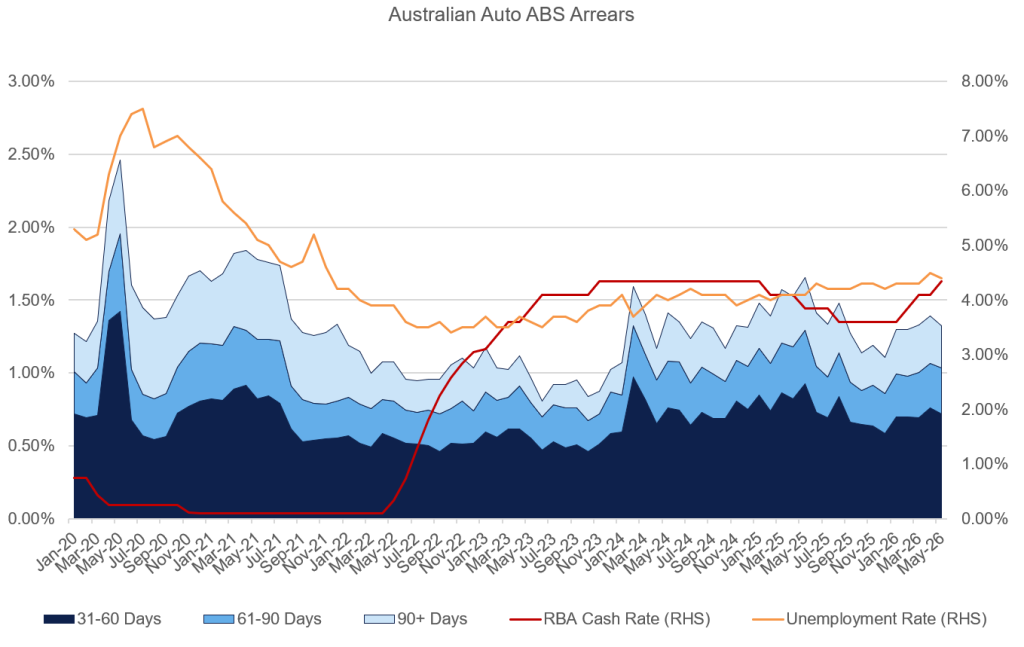
Source: Aquasia, S&P Global SPIN Index May 2026, ABS, RBA
Australian ABS fundamentals remain well supported by a resilient labour market, which continues to underpin borrower repayment capacity despite ongoing cost-of-living pressures. While inflation and higher household expenses have weighed on household budgets over recent quarters, employment conditions remain robust. Australia’s unemployment rate held at 4.4%3 in June 2026, below market expectations and still low by historical standards, reinforcing the positive backdrop for household credit performance. For ABS investors, this is particularly important as employment and disposable income are among the key drivers of arrears and default performance. As a result, collateral performance across Australian ABS pools has remained resilient, with borrower stress yet to translate into a material deterioration in credit metrics.
Combined with the stronger-than-expected labour market data, the latest CPI figures point to an economy that is cooling without a meaningful deterioration in employment conditions. For ABS markets, this is a constructive outcome, as easing inflation should gradually improve household cash flows while reducing the likelihood of further RBA policy tightening. A more stable interest rate environment would help support borrower serviceability and underpin collateral performance across securitised loan pools.
While consumer and business confidence remain subdued, reflecting lingering cost-of-living pressures, the combination of resilient employment, easing inflation and stable economic activity provides a favourable backdrop for Australian ABS. In this environment, arrears and losses are expected to remain well contained, supported by borrowers’ continued ability to meet repayments and the structural protections embedded within ABS transactions.
Independent rating agency views confirm this outlook, Fitch Ratings expects near-term auto ABS losses to remain low4 identifying key downside risks as deterioration in employment conditions and declines in used car prices, which can impact recovery values.
Key structural features that strengthen auto ABS credit quality
Auto loans typically experience higher defaults and losses than mortgages, but their behaviour is more predictable. Because car depreciation schedules are relatively stable, recoveries can be forecast with greater confidence. This gives greater confidence in expected losses, allowing each security to be structured with strong certainty around interest and principal repayment.
Structural protections in auto-ABS transactions are calibrated so that AAA ratings can still be achieved. The first line of defence in an auto-ABS deal is excess spread. Auto loans carry higher interest rates than mortgages, so after paying note coupons and expenses, there is residual income that is returned to the originator. That income can cover early losses before any principal impairment is considered.
Shorter loan terms also help. Auto loans typically run for about two to seven years, versus 15 – 30 years for mortgages. Faster principal repayment causes subordination to build more quickly, increasing credit enhancement for senior and mezzanine notes as the pool amortises.
Recovery dynamics are another strength. Used car values have generally been supported by high new car prices and constrained supply. This improves recoveries when defaulted vehicles are sold, lowering loss-given-default.
Additionally, ABS pools are typically backed by a higher number of receivables than RMBS pools, as the underlying loans are generally much smaller in size. This greater granularity enhances diversification and reduces exposure to any single borrower, supporting more resilient investor outcomes.
Finally, structural protection for lower-rated ABS tranches is often higher than for comparable RMBS tranches. For example, a BB-rated tranche in an Australian auto-backed transaction might sit at roughly twice the level of subordination seen in a BB RMBS tranche, providing extra loss absorption beneath it.
What must go wrong before auto ABS investors take losses
For rated auto ABS tranches, several protective layers must be exhausted before investors suffer principal loss. Understanding this sequence is critical when assessing downside risk.
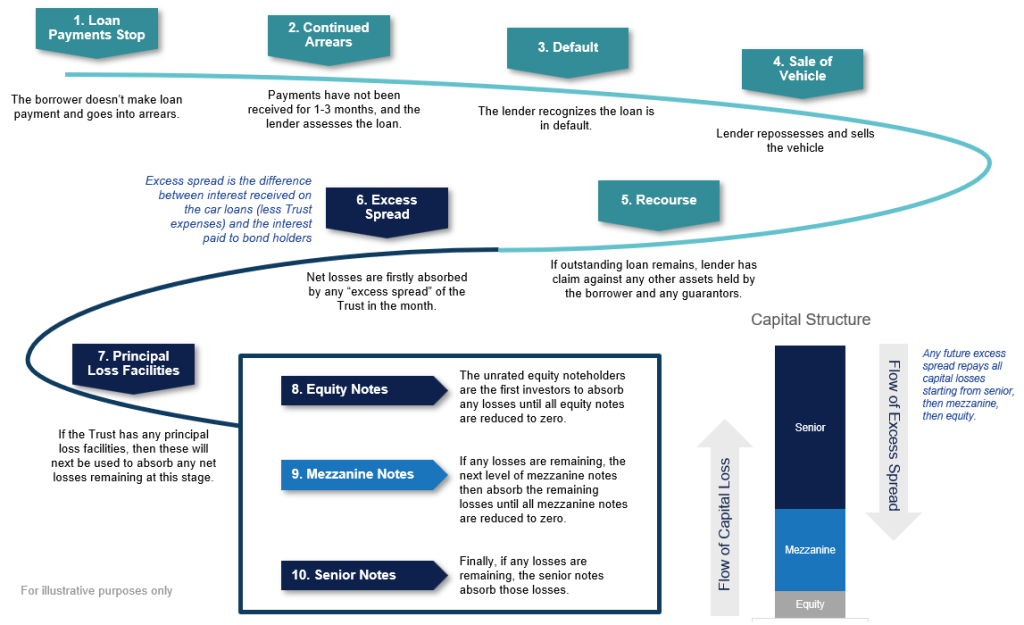
Because excess spread and subordinate tranches absorb losses first, senior and many mezzanine investors only face loss if both default frequency and loss-given-default are significantly worse than the conservative stresses used at issuance. These are important scenarios for risk managers to model, but they would have to be both severe and prolonged before well-structured, investment-grade tranches experience principal loss.
In normal and mildly stressed environments, arrears may trend higher, but structural protections are intended to ensure timely payment of interest and ultimate repayment of principal by legal final maturity.
- Westpac, Australian Securitisation, 1 H H 2026 Securitisation Update
- S&P Global Ratings, Auto ABS SPIN Index April 2026
- Australian Bureau of Statistics (ABS), Labour Force, Australia, June 2026 (released 23 July 2026): unemployment rate 4.4%.
- Fitch Ratings, NRAC: Australian Auto ABS Performance Steady Amid Solid Issuance March 2026
Disclaimer: This commentary is prepared by Aquasia Pty Ltd ABN 20 136 522 051, AFSL 337872 (Aquasia) for general information purposes and does not constitute financial or investment advice or recommendation or an offer to buy or sell any financial product. It does not take into consideration any person’s objectives, financial situation or needs and should not be used as the basis for any investment or financial decision. Past performance is not a reliable indicator of future performance.