
Listed private credit refers to exchange-listed investment vehicles that provide exposure to private loans while trading like shares on the exchange. These structures offer daily liquidity, but their prices can deviate from the vehicle’s underlying net asset value (NAV) depending on how the market views the credit quality and return capability of the portfolio.
Comparing U.S. BDCs and Australian Listed Investment Vehicles
A Business Development Company (BDC) is a U.S. regulated investment company that employs structural leverage to provide loans to middle-market businesses. BDCs issue both debt (generally in the form of unsecured notes) and equity to finance their investments, where debt providers rank above shareholders in priority of cash flows and allocation of losses. This structural leverage can boost returns but can also amplify losses, depending on performance. In contrast, an Australian listed credit vehicle, typically an ASX‑listed investment company (LIC) or unit trust (LIT), generally invests in secured, predominantly asset‑backed credit such as real estate, generally with minimal or no permanent leverage. As a result, BDC distributions depend heavily on leveraged net interest income, whereas Australian listed credit vehicle distributions more closely track portfolio yield and credit quality.
The S&P BDC index is down over 23% on a price return basis over the last 12 months.
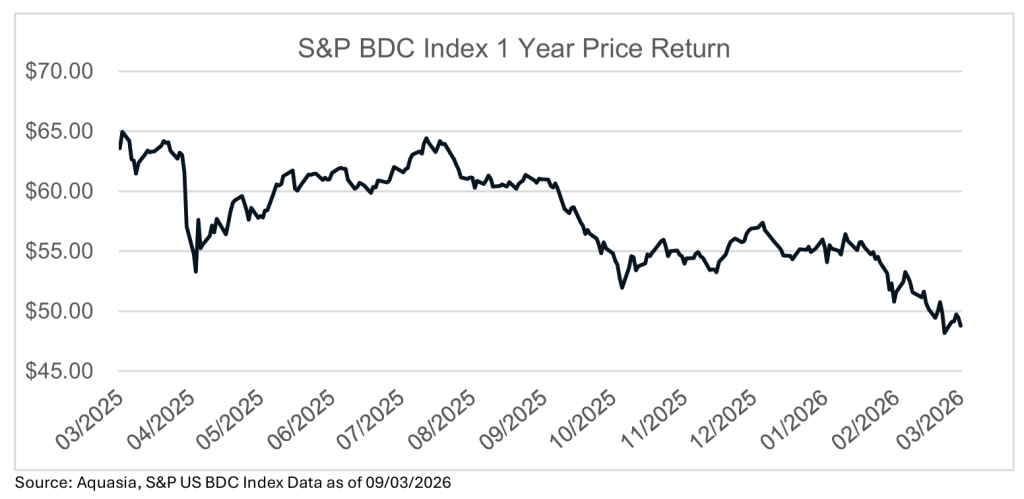
The BDC market is currently trading at an average discount of roughly 22.7% to NAV, with the steepest individual discounts seen in OFS Capital at about 65% of NAV and ICMB at roughly 61%1, making them the two most heavily discounted BDCs in the sector. The Australian market is much less dislocated, however most listed credit investment companies and trusts are currently trading below their NAVs, with a weighted average discount of 5.4%. Notably, the Metrics Real Estate Multi‑Strategy Fund trades at a 22% discount, while the Metrics Income Opportunities Trust sits close behind at 21.8%2. Overall, the Australian listed credit market is trading at historically high discounts, highlighting pronounced market dislocation.
Why is the BDC market selling off?
1. Rising investor contagion across the industry
Growing concern about credit quality continues to pressure the U.S. private credit market. A series of high‑profile borrower failures, most notably the 2025 bankruptcies (fraud-induced) of First Brands and Tricolor, has intensified scrutiny of underwriting standards and sector exposures, particularly in software and finance. Subsequent fraud indictments against executives at both companies further eroded investor confidence. Compounding this, U.S. investors worry that AI‑driven disruption could weaken the cash flows and valuations of software borrowers (~20-30% of the BDC market), raising credit‑impairment risks for BDCs with heavy exposure to the sector. This has sparked a major sell-off in the market, bringing BDC trading prices well below their NAVs.
In saying this, the sell-off does not appear to reflect broader market credit deterioration. Levels of non-accruals (lender has stopped recognising income due to deterioration of loan) among traded BDCs that have recently reported figures remain stable, averaging 2%3. This suggests credit deterioration in certain segments of the market may be idiosyncratic rather than broader market issues.
2. Declining base rates and elevated levels of PIK income have created earnings headwinds
BDC’s earn more when floating rate assets pay more. Declining base rates and rising proportions PIK income (capitalising interest paid at maturity) are adding earnings pressure. With BDC loan portfolios largely floating‑rate, the Federal Reserve’s late‑2025 rate cuts have reduced asset yields and contributed to weaker net investment income and tighter dividend coverage. Rating agencies expect additional rate reductions in 2026, while global geopolitical risks create further uncertainty for inflation and policy easing. Elevated PIK income (closer to post‑COVID highs) raises concern when driven by loan restructurings that shift cash interest to PIK, often signalling borrower strain. PIK is generally more sustainable in secured, real‑asset‑backed lending than in unsecured corporate credit.
3. Heightened competition to maintain pressure on deal terms
Fitch Ratings believes heightened competition for private credit assets will drive a continuation of borrower-friendly loan terms, including tight spreads, structured PIK and fewer/looser covenants. This has already led to several BDCs announcing dividend cuts in late 2025, including Midcap Financial Investment Corp (which is affiliated with Apollo) reducing the dividend by 18%, and FS KKR Capital Corp. slashing theirs in Feb 2026 by ~30%.
4. Structural funding challenges for BDCs: rising refinancing needs and tighter funding markets
Access to structural leverage has become tighter, coinciding with a spike in unsecured notes issued by BDCs maturing in 2026. This raises risks around refinancing costs, leverage stability and future dividend capacity. Of the BDC’s which require refinancing in 2026, 60% have pre-funded with a median spread of 195bps. We expect BDC’s with higher software exposure to price much wider, indicated by Blue Owl Technology pricing at a spread of 60bps over the median at 255bps4. Higher refinancing costs will compress net interest income, already under pressure from declining base rates, and ultimately place downward pressure on equity dividends as less earnings remain for distribution to investors.
Comparing U.S BDCs with Australian listed credit:
1. Asset mix
Investors must be aware of the stark differences in asset mixes of U.S listed vehicles vs. Australian listed vehicles. Globally, the flash‑point has centred on software‑as‑a‑service (SaaS), and lending to cash‑flow businesses, where limited hard asset security meets potential AI‑related disruption, a combination that heightens uncertainty around recovery values.
By contrast, Australia’s listed credit ecosystem skews to real‑asset‑backed lending, notably residential real estate (first‑mortgage, construction‑adjacent) and asset‑backed facilities. Corporate direct lending exists but typically with more tangible collateral than U.S. software loans. This mix helps explain why sector‑wide non‑performing loan spikes seen offshore haven’t materialised domestically to date (though idiosyncratic property risks remain and governance standards are in regulators’ sights).
2. Market repricing – differential between market price and net asset value
Listed credit securities historically move from premium → discount → premium again with rate cycles and credit-worry cycles. Current discounts to NAV in Australian LICs and LITS are not unprecedented when compared with the historical cycles in the BDC market and may indicate a valuation reset rather than a solvency issue:
| Period | BDC Share Price/NAV Ratio | Context |
| Sep 2015 (pre-hike low) | 0.83x | Energy/credit concerns |
| Jan 2016 (selloff trough) | 0.81x | Energy sector stress |
| Aug 2016 (recovery) | 1.00x | Credit stabilization |
| March 2020 (COVID low) | 0.63x | Pandemic-driven selloff |
| Late 2024 (recent high) | 1.10x | Strong BDC fundamentals |
| Feb 2026 (current) | 0.83x | Credit/rate sentiment discount |
| Long-term average | 0.97x | Aug 2011 – Feb 2026 |
Source: Aquasia, VanEck “What is Driving BDC Valuations” March 2026
3. Leverage
BDC and LIC/LIT vehicle structures and leverage differ. U.S. BDCs are corporate, externally managed vehicles that routinely employ structural leverage via unsecured notes within statutory asset‑coverage limits, magnifying both income and volatility. Investors must consider leverage when comparing BDCs with Australian listed credit vehicles. BDCs routinely use structural debt to enhance returns, but this same leverage amplifies losses when credit quality deteriorates. Australian listed vehicles are typically less levered, offering more stable income profiles with lower sensitivity to market shocks and funding‑cost pressures.
4. Liquidity vs. market volatility
Both BDCs and Australian LICs and LITs offer daily liquidity but are exposed to market volatility – trading prices can fall sharply on uninformed retail sentiment rather than fundamentals of the underlying loan portfolio. While investors can exit daily, they may be forced to sell at a discount to NAV – an effective loss of capital.
By contrast, the unit price for an unlisted private credit fund with the same portfolio directly tracks the fund’s NAV and is not exposed to sentiment driven market movements. Private credit investors should assess whether access to daily liquidity offered by listed credit vehicles is worth the market volatility and may consider the suitability of unlisted credit funds amid current private‑credit sentiment headwinds.
- BDC Investor, 19 March 2026 ↩︎
- Aquasia, Bloomberg 16 March 2026 ↩︎
- JP Morgan Private Bank – Private Credit Under the Microscope ↩︎
- Fitch Ratings: Recent U.S. BDC Debt Issuance Lowers Refinancing Risk of 2026 Maturities ↩︎
Disclaimer
This commentary is prepared by Aquasia Pty Ltd ABN 20 136 522 051, AFSL 337872 (Aquasia) for general information purposes and does not constitute financial or investment advice or recommendation or an offer to buy or sell any financial product. It does not take into consideration any person’s objectives, financial situation or needs and should not be used as the basis for any investment or financial decision. Past performance is not a reliable indicator of future performance.