Background
We typically see the trailing 1-year performance of ASTIF compared to current 1 year TD rates in the market. This analysis is flawed.
Whilst this may be a useful comparison in an environment where the rates curve is entirely flat for a prolonged period of time, this has not been the case in recent history with central banks having oscillated from hawkish to dovish and now back to hawkish again in the past 3 years.
However, with ASTIF and TD’s both aiming to provide a return over the RBA cash rate, this results in a flawed comparison where one is looking at a performance number over a trailing 12-month cash rate vs one against the one year forward rate.
Backward looking analysis – Flawed
For example, as at 30 September 2026, the trailing ASTIF 1 year performance is 4.91% (Institutional Units). Compared to an average, current, 1 year TD rates being offered at 5% this may look like TDs are the superior return option. However, the ASTIF performance is actually +91bps over the cash rate over the trailing 12-month period, while the 5% TD1 is +40bps over the current cash rate.
Forward looking analysis – Comparing apples with apples2
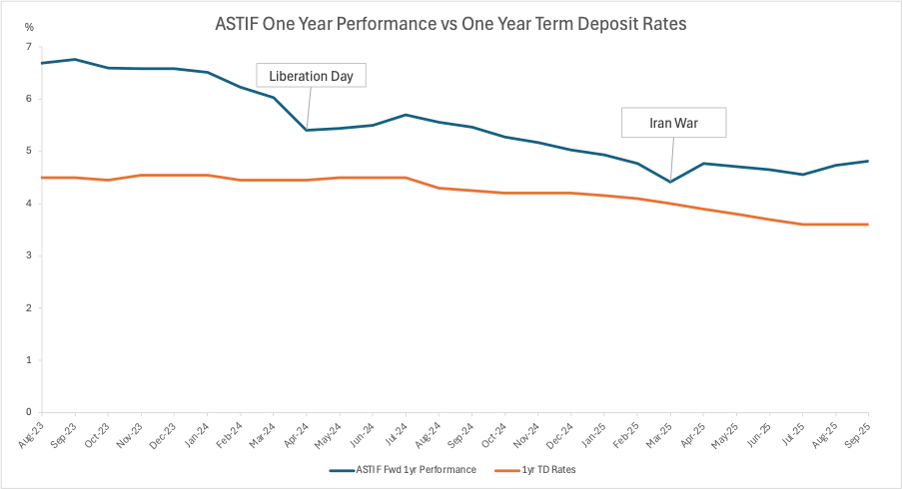
In this comparison, ASTIF having reached its 3-year anniversary, we have analysed the forward performance of capital invested for one year in ASTIF vs TD from Fund inception in August 2023 to September 2025. So, apples with apples. The chart demonstrates the one-year performance of ASTIF has consistently outperformed one year TD rates since inception of the Fund in August 2023.
The quantum of the outperformance (and ASTIF’s own performance) does fluctuate as a result of the Fund being subject to market movements with securities that are marked to market daily. This is particularly pronounced during periods of market stress as seen during Liberation Day (April 2024) and the Iran War (March 2025). (It is worth noting ASIT’s current trailing 12-month volatility is 0.25%). Comparatively, TD’s will lock in your future 12-month returns (albeit at a lower rate).
Optionality and Credit Risk
The other key difference worth highlighting is optionality on redemptions. With TD’s, earlier access to your capital is typically only possible with the forfeiture of the majority (or even entirety) of your interest vs ASTIF which provides daily redemption windows at the cost of the bid/ask spread (currently 5bps each way).
From a risk perspective, ASTIF only holds Investment Grade securities (as rated by Fitch, Moody’s or S&P) with the latest September 2026 figures showing 52% of the Fund in AAA securities. TD’s are government guaranteed for the first $250k with any subsequent amounts then linked to the underlying credit rating of the TD provider (the Major banks as an example are all rated AA-).
For more information, please reach out:
Stuart Richardson
stuart.richardson@aquasia.com.au
James Westbury
Disclaimer
This commentary is prepared by Aquasia Pty Ltd ABN 20 136 522 051, AFSL 337872 (Aquasia) as trustee and investment manager of the Aquasia Short Term Income Fund (Fund) for information purposes to wholesale clients (as defined in the Corporations Act 2001). It contains general information and does not constitute personal financial or investment advice or recommendation or an offer to buy or sell any financial product. It does not take into consideration any person’s objectives, financial situation or needs and should not be used as the basis for any investment or financial decision.
Past performance is not reliable indicator of future performance. Aquasia does not guarantee repayment of capital or any particular rate of return from the Fund. Recipients should refer to the Fund’s IM and seek independent financial advice and input from accounting, tax, legal and other professional advisors. Any opinions and estimates included in this commentary constitute judgments of Aquasia as at the date of this document. While Aquasia believes the content is based on reliable information, no warranty is given to its accuracy and persons relying on this information do so at their own risk. To the extent permitted by law, no liability is accepted by any of Aquasia or its directors, officers, employees, contractors, agents or associates (Aquasia Parties) for any loss, damage or liability (including for negligence) suffered or incurred in connection with this document or its contents. Aquasia Parties and their clients may trade in or hold some of the financial products mentioned in this commentary. The contents of this document are confidential and subject to copyright.