
Australia’s housing market has softened, with national home values falling 0.7% in July 2026, the largest monthly decline since December 20221. Property downturns are an inevitable part of the market cycle; however, residual stock loans are designed to withstand periods of falling property values through conservative LVRs and other structural credit enhancements that provide meaningful downside protection whilst giving investors the opportunity to earn high single digit returns net of fees and costs.
Why Residual Stock Loans Exist
A residual stock loan facility is a financial arrangement that allows residential property developers with unsold but finished product to refinance those properties into a lower cost debt facility. The finance raised by using this “residual” stock as collateral is at a lower cost because it is lower risk than a developer’s construction finance and because the secured properties2 are completed and marketable. The individual properties in the residual stock pool have each received a certificate of title and are ready to be bought by owner occupiers or investors. The recent tax changes still allow investors who buy new builds to benefit from negative gearing arrangements and the 50% CGT discount. The lower cost finance gives the developer more time to successfully sell the stock compared to a situation where the stock is being funded at the higher rate that comes with a construction finance facility. Through this facility, the developer can recycle their capital faster and get on with their next project.
Indicative Key Loan Terms:
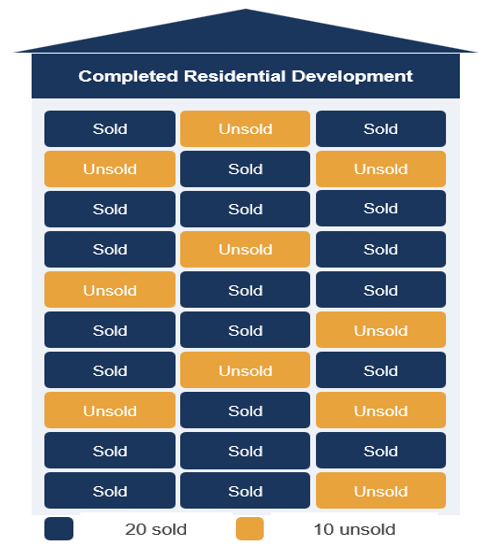
- 30 residential apartments 20 sold, 10 unsold apartments (the residual stock)
- First ranking mortgage over unsold stock
- Average value of residual stock: $1,000,000 per apartment
- Collateral Available : $10m (10 x $1m)
- Rates: 1% upfront fee, 8% interest rate
- LVR limit: 70%
- Loan amount: $7m (based on 70% of $10m)
- Loan maturity: 18 months
- Sales requirement: Once every two months, 100% of proceeds paid to Lenders
The opportunity – The Aquasia Residual Stock Fund
| Aquasia Residual Stock Fund: Key Information Full details in the Fund’s Information Memorandum (IM) | |
| Asset Class | Alternatives – Private Credit |
| Target Return Range | 7-9% net of fees and costs |
| Suitable for | Wholesale investors seeking fixed income style distributions backed by mortgages held against marketable residential real estate in an alternative to private credit pools containing real estate construction and corporate credit risks. |
| Applications / Redemptions | Monthly applications and quarterly redemptions3 |
| Distributions | Quarterly4 |
Aquasia launched the Aquasia Residual Stock Fund (Fund) in November 2025 to provide targeted exposure to this niche segment of Australian private credit. The strategy gives investors exposure to loans for completed residential properties without exposing the portfolio to risks such as building construction, land rezoning, etc which have less certainty around marketability and valuation, and a greater degree of illiquidity. There is also no corporate credit risk related to the builder or the developer because the loan is repaid by the sale proceeds of each residential property settlement. The pool’s exposure is limited to the individually titled and marketable real estate assets.
The risk profile is materially different from construction finance. The development project is complete, individual titles have been issued, and buyers can inspect and buy the finished product. This removes completion risk, cost-to-complete uncertainty and builder delivery risks that are typically present in other real estate debt portfolios. This simplifies the repayment risk in the loan down to whether the properties are sold, or not, and the realised price. The Funds mandated LVR parameters mitigate this risk.
The Aquasia Residual Stock Fund’s IM sets out additional risk mitigants, such as limiting lending to Australian metro areas (as defined by Standard & Poor’s) where a higher demand for the product is generally expected. Additionally, the fund will not consider projects with limited pre-sale evidence or weak market acceptance. Due diligence focuses on stock mix, valuation evidence, settlement assumptions, location, borrower quality and buyer demand.
One of the more attractive structural features of a residual stock loan is its de-leveraging nature. This occurs when stock sales occur and part of the residual stock loan is repaid. The deleveraging can be demonstrated by considering the indicative loan on page 1 above. If one of the secured properties is sold for $1,000,000, the facility outstanding reduces from $7m to $6m and the collateral backing the loan reduces from $10m to $9m. As a result, the “loan to value” or LVR falls to 67% from the LVR of 70% at the loan’s inception. Each time a sale occurs, the LVR trends lower in this manner, providing a ‘de-risking’ of the position whilst maintaining initial rates of interest. In other words, the return is stable while the risk is reducing.
This worked example assumes all cash is passed through directly to lenders. Sometimes, when the LVR is below a certain threshold (say 55%), part of the sale proceeds are paid to the developer as an equity release. This has the effect of slowing down the rate of repayment of the facility and is a feature that can be attractive to both the borrower and lender.
Other key structural features typically include conservative LVRs, first mortgage security, short loan terms5 and cash interest servicing. As set out in the IM, loans must have a maximum 75% LVR at inception and the Fund targets a weighted average portfolio LVR of 70%6. LVRs are based on independent valuations. In Aquasia’s view, this provides a buffer against borrower default, insolvency and potential property value falls. For context, Cotality data shows the largest combined capital city dwelling value decline over the past 40 years was 8.2% between 2017 and 2019, with the 2022–23 downturn slightly lower at 8.1%7. While past performance is not a guide to future outcomes, these declines sit well within the Fund’s targeted LVR buffer.
Closing Statement
Despite the current sombre outlook for residential property market prices, other market dynamics continue to support the residual stock loan asset class. Elevated construction costs and ongoing supply constraints have increased the strategic value of completed residential properties and there exists a well-known structural mismatch between housing supply and housing demand. Because residual stock loans are secured against completed properties, they are not exposed to construction risks, cost overruns or development execution risks which are all present in a portfolio containing higher risk real estate loans. The assets are valued using contemporaneous market data from independent and qualified real estate valuers, this provides transparency for lenders and supports robust credit underwriting.
As mentioned above, the resilience of residual stock loans stems not only from favourable market dynamics but also from their structural design. Conservative loan-to-value ratios, diversified security pools, cash flow waterfalls and significant borrower equity provide multiple layers of downside protection, helping preserve capital and mitigate the risks of declining property prices.
- Cotality, Australia’s housing market downturn widens, August 3 2026 ↩︎
- Completed properties include completed residential dwellings or land lots ↩︎
- Redemptions will not be possible until the quarter ending on 30 September 2026. ↩︎
- To the extent that income is available ↩︎
- It is expected that loans will typically have an expected life of 6-18 months. ↩︎
- Loan portfolio LVR only applicable from 30 September 2026 ↩︎
- Cotality Housing Chart Pack May 2026, as reported in “Cotality report: Rising rates signal market turning point” ↩︎
Disclaimer
This commentary is prepared by Aquasia Pty Ltd ABN 20 136 522 051, AFSL 337872 (Aquasia) as trustee and investment manager of the Aquasia Residual Stock Fund (Fund) for information purposes to wholesale clients (as defined in the Corporations Act 2001). It contains general information and does not constitute personal financial or investment advice or recommendation or an offer to buy or sell any financial product. It does not take into consideration any person’s objectives, financial situation or needs and should not be used as the basis for any investment or financial decision.
Past performance is not reliable indicator of future performance. Aquasia does not guarantee repayment of capital or any particular rate of return from the Fund. Recipients should refer to the Fund’s IM and seek independent financial advice and input from accounting, tax, legal and other professional advisors. Any opinions and estimates included in this commentary constitute judgments of Aquasia as at the date of this document. While Aquasia believes the content is based on reliable information, no warranty is given to its accuracy and persons relying on this information do so at their own risk. To the extent permitted by law, no liability is accepted by any of Aquasia or its directors, officers, employees, contractors, agents or associates (Aquasia Parties) for any loss, damage or liability (including for negligence) suffered or incurred in connection with this document or its contents. Aquasia Parties and their clients may trade in or hold some of the financial products mentioned in this commentary. The contents of this document are confidential and subject to copyright.